

Week 2-3: Integration - Building an ML Engine from First Principles
Week 2-3: Linear Algebra & Calculus Essentials (Days 8-22)
1. Introduction
Most engineers learn linear algebra and calculus as isolated exercises: dot products on paper, partial derivatives in notebooks, gradient descent as a one-off plot. That knowledge rarely connects to how production systems actually run—HTTP handlers, validation, training loops, and structured responses.
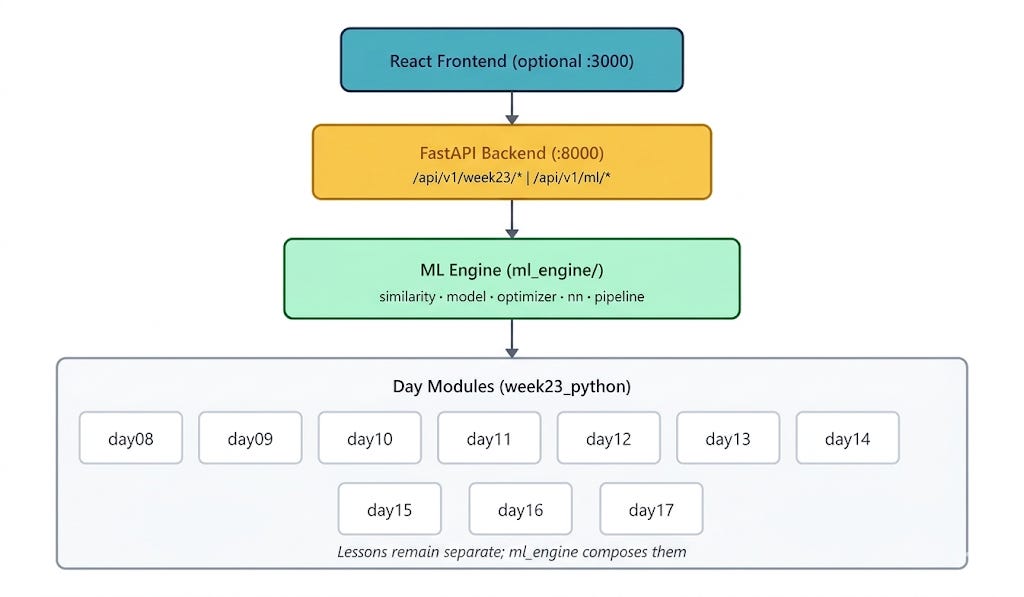
The week-2 Integration closes that gap. It unifies Week 2–3 curriculum (Days 8–16) into a single ML Engine: a Python package that composes lesson modules, exposed through FastAPI and an optional React lab UI. The goal is not to replace frameworks like PyTorch, but to show how fundamentals become a coherent system you can reason about, test, and extend.
2. System Overview
The architecture uses a dual-layer API:
LayerPrefixRoleLearning/api/v1/week23/dayXX/Per-day lesson endpoints (Days 8–16)Product/api/v1/ml/Unified ML engine (recommend, train, predict, NN)
Components:
Python package (
packages/week23_python/) — ported day modules plusml_engine/FastAPI backend (
backend/) — routes, request models, error handlingML Engine — composes day code into similarity, regression, optimization, and neural-net operations
Optional frontend (
frontend/) — React + Vite “AI Math Lab” calling/api/v1/ml/*
Dependency rule: ml_engine imports day modules; day modules never import ml_engine. Lessons stay teachable; the engine stays the integration point.
3. Architecture Diagram
→ Get “AI Field Engineer’s guide” ebook with paid subscription
→ Subscribe now & access full source code repository with 200 + coding lessons
Github Link:
https://github.com/sysdr/aiml-p/tree/main/week_2_3_aiml_integrated_project
