Week 15–16 : Reinforcement Learning & Other Topics (Days 99-112)
Preparing for Job Interviews explore preparation material - here
Subscribe to get Free copy of AI Engineer’s Blueprint
Introduction
Reinforcement learning and recommender systems usually arrive as separate lesson repos: a grid-world Q-learning script here, a MovieLens notebook there. That works for studying algorithms in isolation. It breaks when you need one deployable service that trains policies, serves hybrid recommendations, exposes curriculum demos over HTTP, and gives operators a live dashboard.
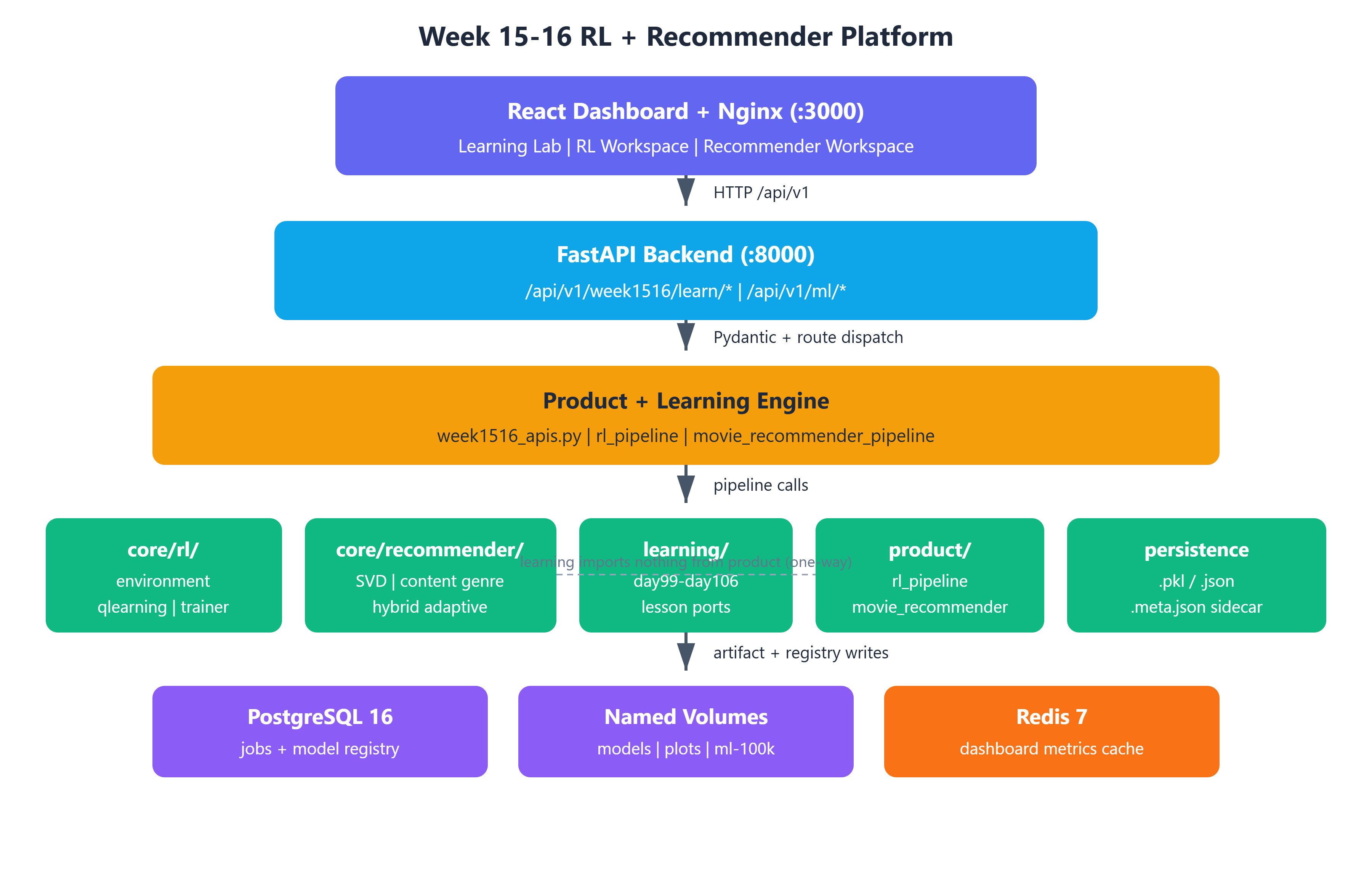
week_15_16_aiml_integrated_project unifies Days 99–112 into a single Dockerized stack:
A learning layer that exposes each lesson through structured FastAPI routes.
A core layer that holds canonical RL and recommender implementations.
A product layer that runs grid-world training and MovieLens hybrid workflows end-to-end.
A React dashboard behind nginx for learners and operators.
You will walk away knowing how Q-learning agents, collaborative SVD, content-based filters, and adaptive hybrids become modules inside one engine—not a pile of disconnected notebooks.
System Overview
Runtime shape stays deliberately small:
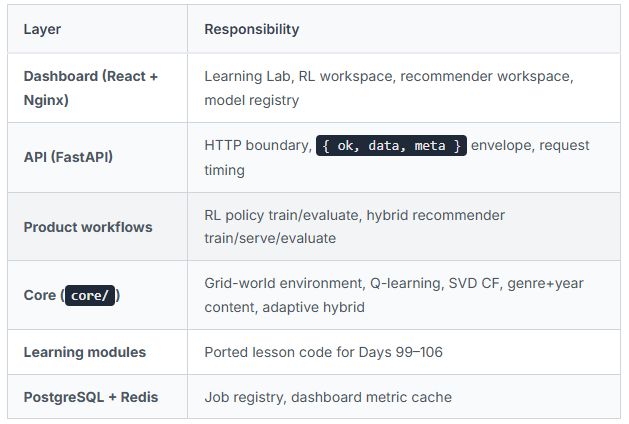
Original lesson folders (day99/ … day106_to_day112/) in the parent repo stay read-only. Logic is re-homed into packages/week1516_python/ with explicit one-way imports: learning/ never depends on core/ or product/.
Days 99–112 operationalize inside the system as follows—without re-teaching the algorithms:
Days 99–102 feed the RL product path: intro Q-learning, agent/environment comparison, tabular Q-table export, and the Day 102 canonical grid-world agent persisted as JSON policy artifacts.
Days 103–105 power the recommender theory and content-filter learning routes; collaborative user/item similarity and TF-IDF catalog demos run over synthetic or sample data.
Days 106–112 collapse into the MovieLens product pipeline: temporal train/test split, dual artifact persistence (collab + content), and adaptive alpha blending at serve time.
Two routers share the same FastAPI process but serve different audiences. /api/v1/week1516/learn/* returns educational payloads—Q-table snapshots, CF similarity matrices, abbreviated pipeline demos. /api/v1/ml/* returns operator-grade artifacts: policy reward curves, RMSE/MAE scores, ranked movie lists. Both call into the same week1516_python package; only the adapter layer differs.