

Want to learn building AI Agents from scratch ?
Join here Hands On AI Agent Mastery Course
Introduction
Most Week 12 material teaches scikit-learn in isolated notebooks: one day on preprocessing, another on pipelines, another on saving models. That works for concepts, but it breaks down when you need a single deployable system that validates data, trains, persists artifacts, and serves predictions without re-learning the same patterns six different ways.
This project—week_12_aiml_integrated_project—addresses that gap. It unifies Days 71–84 into one stack:
A learning layer that exposes each lesson’s logic through HTTP, unchanged in spirit.
A composition layer that picks canonical implementations for production paths (preprocessing, persistence, validation).
A product layer that runs an end-to-end Titanic survival workflow on top of those choices.
An optional dashboard for live telemetry, training actions, and registry inspection.
The goal is not another tutorial on StandardScaler. It is a system design exercise: how sklearn ideas become modules, how modules become routes, and how routes become something you could ship.
System Overview
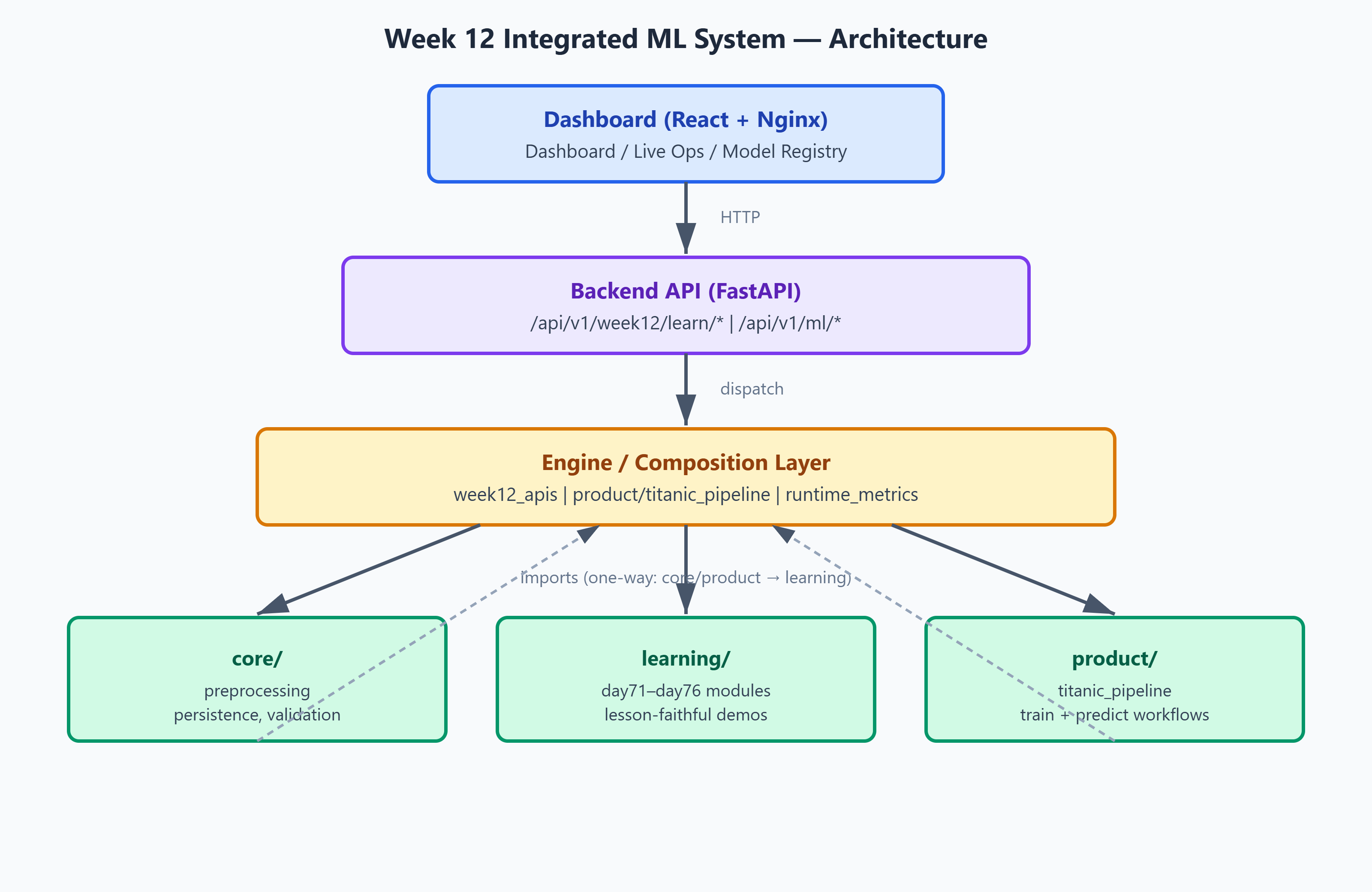
Original lesson folders (day71/ … day76_to_day84/) in the parent repo stay read-only. The integrated project ports code into packages/week12_python/ so imports are stable and the dependency graph is explicit.
One-way rule matters: core/ and product/ may import learning/, but lesson modules never import the composition layer. That keeps pedagogy intact while still allowing a real product path.
Github Link:
https://github.com/sysdr/aiml-p/tree/main/week_12_aiml_integrated_project
Engine and Core System Design
The composition layer is not a second copy of every lesson. It is a policy layer: which lesson implementation wins when two days solve the same problem differently.
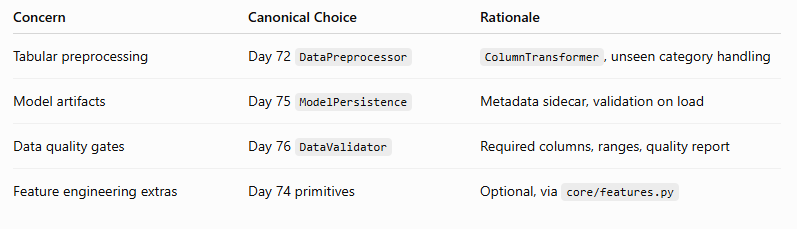
The product workflow (product/titanic_pipeline.py) wires these pieces:
