Day 58: Decision Trees Theory
Teaching Machines to Make Decisions Like Humans
What We’ll Build Today
Understand how decision trees make classifications through a series of yes/no questions
Learn the mathematical principles behind splitting data to maximize information gain
Build a decision tree from scratch to classify customer churn at a SaaS company
Discover how Netflix, Amazon, and fraud detection systems use decision trees in production
Why This Matters: From Linear Boundaries to Complex Decision Rules
Remember your spam classifier from Day 51? It drew a straight line through your data - emails on one side were spam, emails on the other weren’t. But what if your data doesn’t follow a straight line? What if spam detection requires multiple complex rules like “if the email has ‘urgent’ AND comes from an unknown sender AND has 3+ exclamation marks, then it’s spam”?
This is where decision trees shine. While logistic regression asks “what’s the probability?”, decision trees ask “which questions should I ask in which order?” They mirror how doctors diagnose patients, how loan officers approve applications, and how you decide what to watch on Netflix tonight.
At Stripe, decision trees power fraud detection systems processing millions of transactions daily. At Spotify, they help decide which song to play next. At Tesla, ensemble decision trees (Random Forests) help Autopilot classify objects in camera feeds. The algorithm you’ll learn today is foundational to some of the most powerful ML systems in production.
Core Concept: How Machines Learn to Ask the Right Questions
The Decision-Making Tree Structure
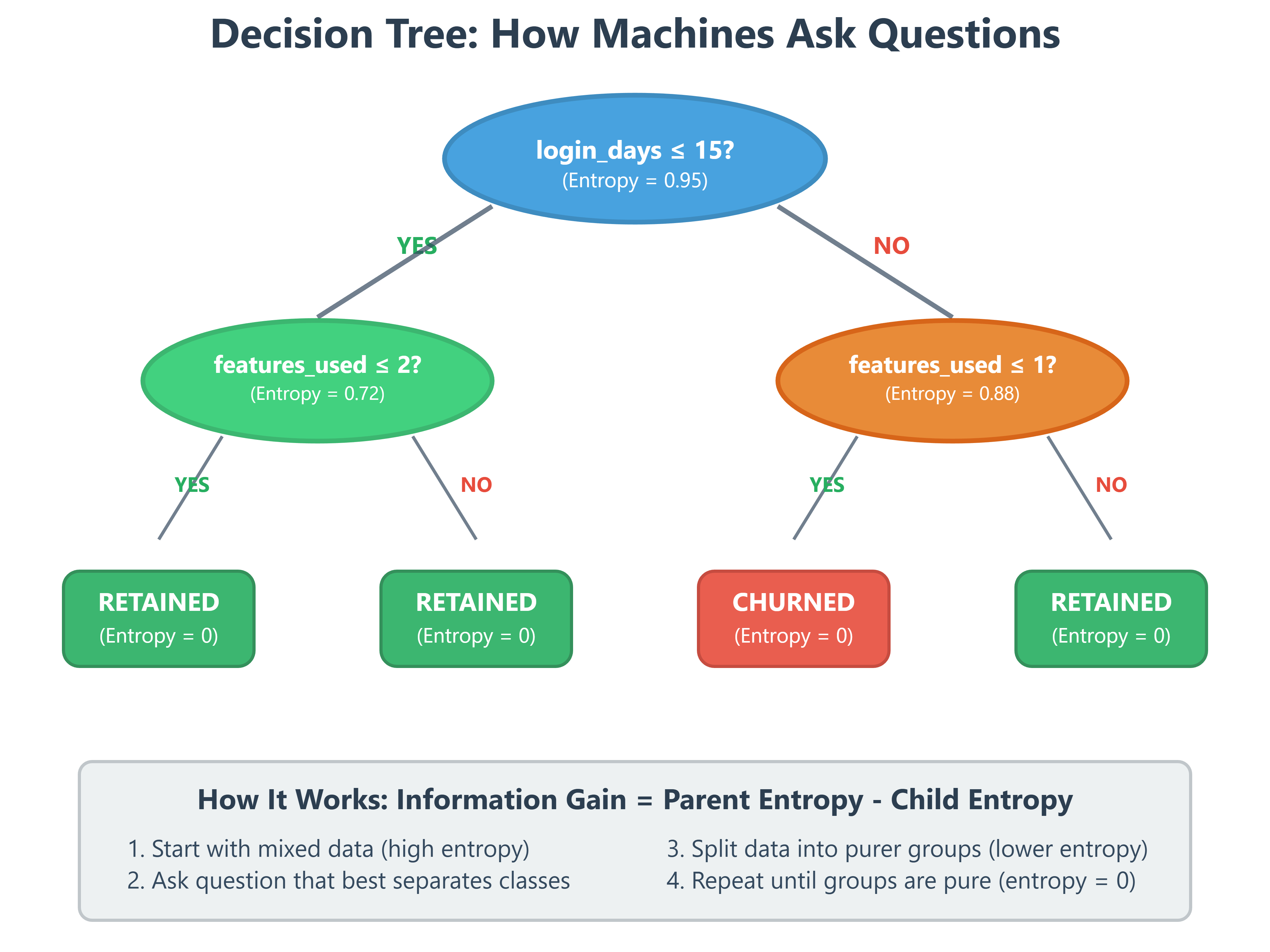
Imagine you’re teaching a friend to identify whether a customer will cancel their subscription. You might ask:
“Has the customer logged in during the past 30 days?”
If NO → “They’ll probably cancel” (CHURN)
If YES → Ask another question: “Do they use more than 3 features?”
If NO → “Might cancel” (CHURN)
If YES → “They’ll stay” (RETAIN)
This is exactly how a decision tree works. Each question is a node, each possible answer creates a branch, and each final outcome is a leaf. The tree structure encodes a series of if-then-else rules that partition your data into increasingly pure groups.