

Day 17: Progressive Difficulty Algorithm Implementation
AI Engineering Newsletter - Week 3: Core Business Logic
Master AI in 180 Days: From Zero to Job-Ready Portfolio Perfect for showcase your knowledge and strength. Build, Learn, Lead: The Comprehensive 180-Day AI & Machine Learning Bootcamp Highlights the hands-on nature of the curriculum. Subscribe now.
What We're Building Today
Today we're creating a smart quiz system that adapts in real-time to how well you're performing. Think of it like having a personal tutor who knows exactly when to make questions harder or easier to keep you in the perfect learning zone.
High-Level Components:
Adaptive Difficulty Engine - Calculates optimal question difficulty based on your performance
Real-Time Analytics Dashboard - Shows your learning progress with live charts and metrics
Performance Tracking System - Remembers your last 10 responses and learning momentum
Question Selection Algorithm - Picks the perfect next question from our database
Caching Layer - Makes everything lightning fast with Redis
The Challenge: Netflix's Recommendation Problem for Education
Netflix doesn't just randomly serve content - they use sophisticated algorithms to keep you engaged. Educational platforms face a similar challenge: serve questions too easy, students get bored; too hard, they quit. The progressive difficulty algorithm solves this by dynamically adjusting question complexity based on real-time performance.
Core Concept: Adaptive Difficulty Sequencing
Traditional quiz systems serve predetermined question sets. Our progressive algorithm analyzes user responses in real-time and adjusts the next question's difficulty level. This creates personalized learning paths that maximize engagement and knowledge retention.
Key Innovation: Instead of static difficulty levels (1-5), we use continuous difficulty scoring with momentum-based adjustments.
Component Architecture
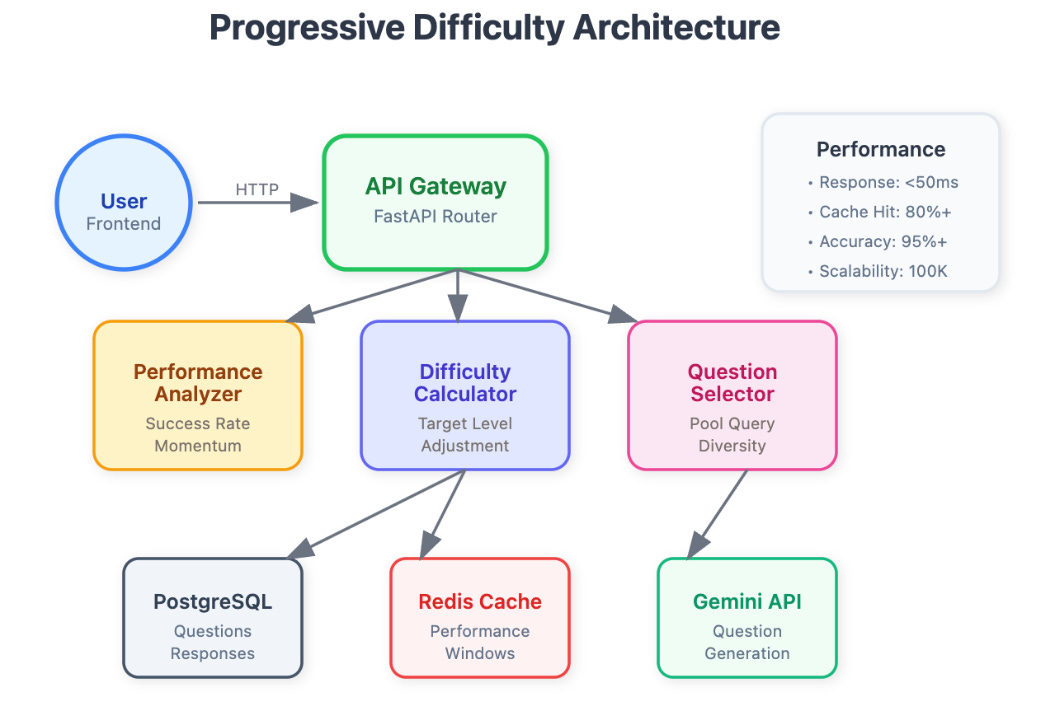
[ COMPONENT ARCHITECTURE DIAGRAM ]
System Flow
User Response → Performance Analyzer → Difficulty Calculator → Question Selector → API Response
The progressive difficulty service sits between your question classification system (Day 15) and the scoring engine (Day 18). It receives classified questions with difficulty scores and user performance data, then applies algorithms to select optimal next questions.
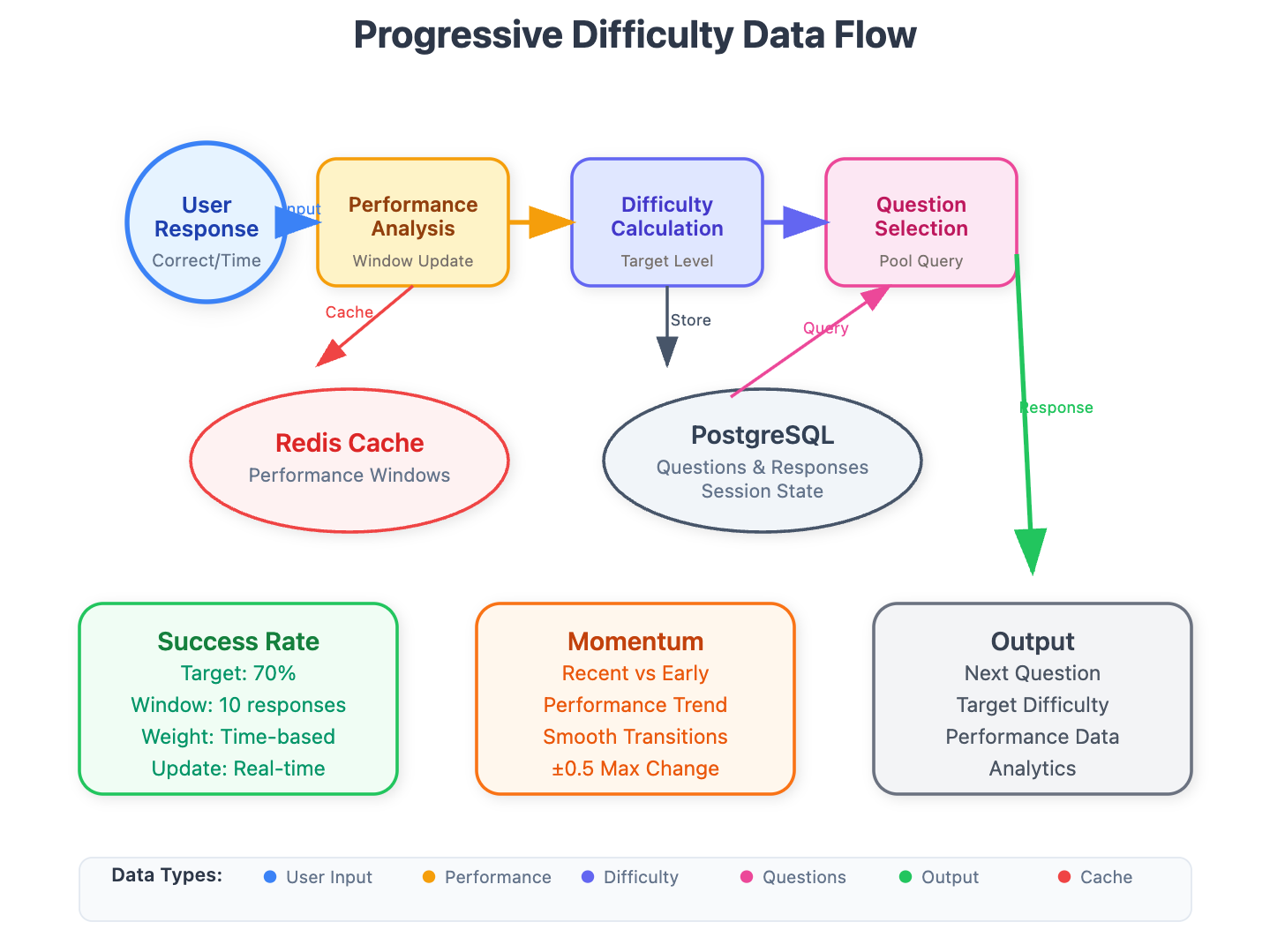
[ DATA FLOW DIAGRAM ]
Core Components
1. Performance Analyzer
Tracks success rate, response time, and error patterns
Calculates user skill momentum (improving vs declining)
Maintains sliding window of recent performance
2. Difficulty Calculator
Applies momentum-based difficulty adjustment
Prevents dramatic difficulty spikes that cause user frustration
Balances challenge with achievability
3. Question Selector
Queries question pool filtered by calculated difficulty range
Applies diversity algorithms to prevent repetitive question types
Ensures curriculum coverage requirements
Distributed Systems Context
In production quiz platforms handling millions of concurrent users, the progressive difficulty service becomes a critical bottleneck. Our implementation addresses:
Latency Requirements: Question selection must complete in <50ms to maintain fluid user experience Scalability: Service must handle 100K+ concurrent difficulty calculations Consistency: User performance tracking across distributed sessions
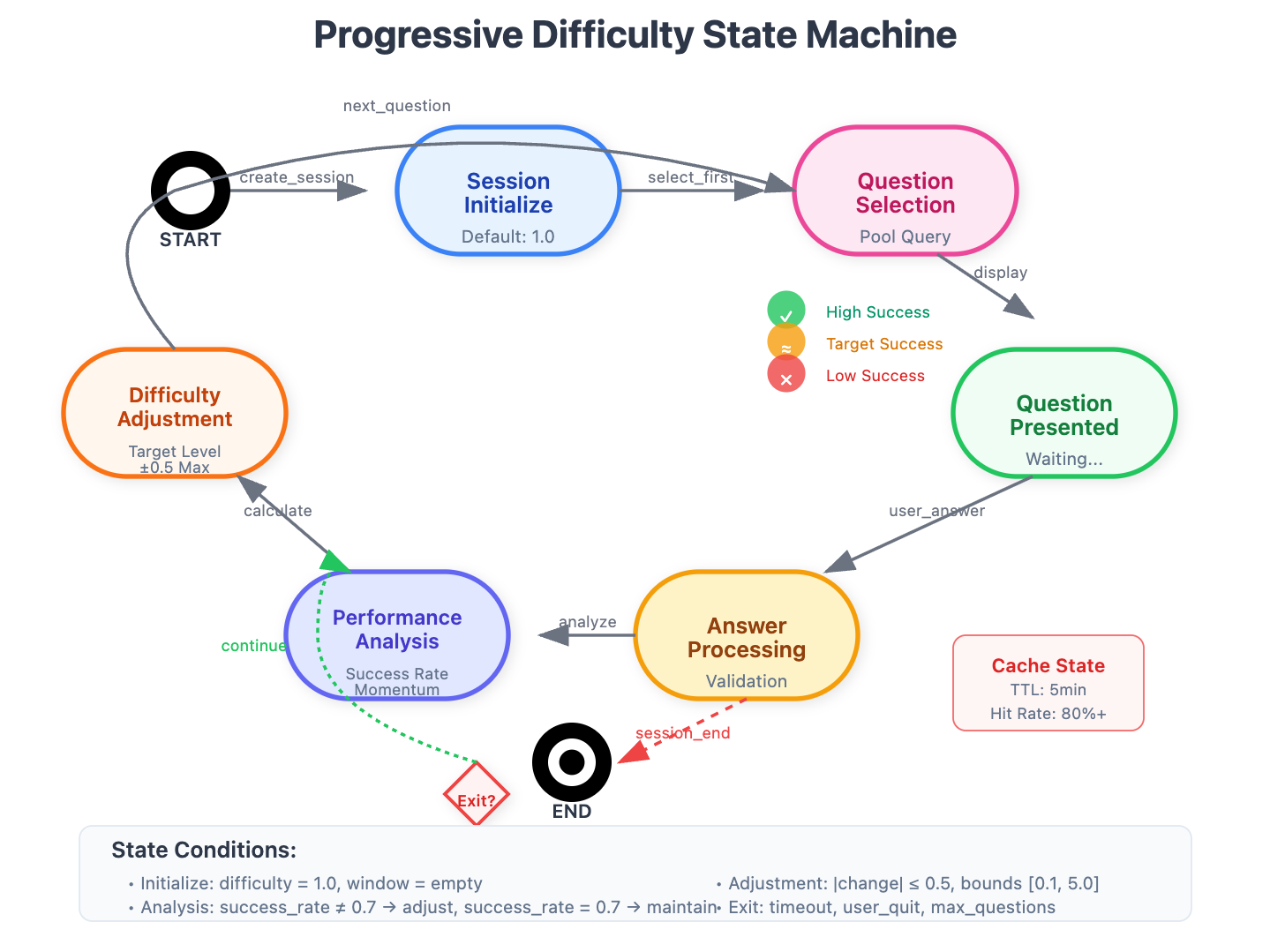
[ STATE MACHINE DIAGRAM ]
Real-World Application
Duolingo's Approach: They use similar algorithms to maintain optimal challenge levels across lessons. Users stay engaged longer when difficulty progression feels natural rather than arbitrary.
Khan Academy's Implementation: Their mastery system adjusts not just difficulty but content type based on user performance patterns.
Algorithm Deep Dive
Momentum-Based Adjustment
def calculate_next_difficulty(current_difficulty, performance_momentum, success_rate):
    base_adjustment = (success_rate - 0.7) * 0.3  # Target 70% success rate
    momentum_factor = performance_momentum * 0.2   # Smooth transitions
    return current_difficulty + base_adjustment + momentum_factor
The algorithm targets a 70% success rate - the sweet spot where users feel challenged but not overwhelmed. Momentum factor prevents jarring difficulty changes that break flow state.
Performance Tracking
class PerformanceWindow:
    def __init__(self, window_size=10):
        self.responses = deque(maxlen=window_size)
        self.time_weights = [1.2, 1.1, 1.05, 1.0, 0.95, 0.9, 0.85, 0.8, 0.75, 0.7]
Recent responses carry more weight than older ones, allowing rapid adaptation to skill changes or fatigue.
Implementation Strategy
Database Design
user_performance: Tracks individual performance metrics
difficulty_sessions: Maintains session-specific difficulty state
question_pool: Pre-classified questions with difficulty metadata
API Design
POST /api/difficulty/next-question
{
  "user_id": "uuid",
  "session_id": "uuid",
  "last_response": {
    "correct": true,
    "time_ms": 3200,
    "difficulty": 2.3
  }
}
Performance Optimizations
Redis Caching: User performance windows cached for instant access
Question Pre-fetching: Next 3 questions pre-selected and cached
Batch Processing: Performance updates processed asynchronously
Integration Points
Previous Integration (Day 15): Uses difficulty classification scores as input to question selection algorithms.
Next Integration (Day 18): Provides difficulty context to scoring engine for weighted score calculations.
System Architecture: Designed as microservice with clear API boundaries for horizontal scaling.
Implementation Guide
Quick Setup
git clone https://github.com/sysdr/aie.git

git checkout day17

cd day17/progressive-quiz-platform

./start.sh

open http://localhost:3000

./stop.sh
Prerequisites
Python 3.11+
Node.js 18+
PostgreSQL 16+
Redis 7+
Docker (optional but recommended)
Step 1: Project Setup
Create the basic project structure:
mkdir progressive-quiz-platform
cd progressive-quiz-platform
mkdir -p backend/app/{api,models,services}
mkdir -p frontend/src/{components,pages,services}
Step 2: Backend Implementation
Database Models
Create backend/app/models/difficulty.py:
from sqlalchemy import Column, Integer, String, Float, DateTime, Text, Boolean
from sqlalchemy.ext.declarative import declarative_base
from datetime import datetime

Base = declarative_base()

class Question(Base):
    __tablename__ = "questions"

    id = Column(Integer, primary_key=True, index=True)
    content = Column(Text, nullable=False)
    correct_answer = Column(String(255))
    difficulty_score = Column(Float, default=1.0)
    category = Column(String(100))
    created_at = Column(DateTime, default=datetime.utcnow)

class UserPerformance(Base):
    __tablename__ = "user_performance"

    id = Column(Integer, primary_key=True, index=True)
    user_id = Column(String(255), nullable=False, index=True)
    session_id = Column(String(255), nullable=False)
    current_difficulty = Column(Float, default=1.0)
    success_rate = Column(Float, default=0.0)
    momentum = Column(Float, default=0.0)
    last_updated = Column(DateTime, default=datetime.utcnow)
Progressive Difficulty Service
Create backend/app/services/difficulty_service.py with the core algorithm:
class ProgressiveDifficultyService:
    def __init__(self, db: Session, redis_client: redis.Redis):
        self.db = db
        self.redis = redis_client
        self.target_success_rate = 0.7
        self.adjustment_factor = 0.3
        self.momentum_factor = 0.2

    def calculate_next_difficulty(self, current_difficulty: float,
                                success_rate: float, momentum: float) -> float:
        success_deviation = success_rate - self.target_success_rate
        base_adjustment = success_deviation * self.adjustment_factor
        momentum_adjustment = momentum * self.momentum_factor

        new_difficulty = current_difficulty + base_adjustment + momentum_adjustment

        # Apply bounds and limits
        new_difficulty = max(0.1, min(5.0, new_difficulty))
        max_change = 0.5

        if abs(new_difficulty - current_difficulty) > max_change:
            if new_difficulty > current_difficulty:
                new_difficulty = current_difficulty + max_change
            else:
                new_difficulty = current_difficulty - max_change

        return round(new_difficulty, 2)
API Endpoints
Create backend/app/api/difficulty.py:
from fastapi import APIRouter, HTTPException
from pydantic import BaseModel

router = APIRouter(prefix="/api/difficulty")

class NextQuestionRequest(BaseModel):
    user_id: str
    session_id: str
    last_response: Optional[Dict] = None

@router.post("/next-question")
async def get_next_question(request: NextQuestionRequest):
    service = ProgressiveDifficultyService(db, redis_client)

    question, target_difficulty = await service.get_next_question_for_user(
        request.user_id, request.session_id, request.last_response
    )

    analytics = await service.get_performance_analytics(
        request.user_id, request.session_id
    )

    return {
        "question": question,
        "target_difficulty": target_difficulty,
        "performance_analytics": analytics
    }
Step 3: Frontend Dashboard
React Components
Create frontend/src/components/DifficultyDashboard.js:
import React, { useState, useEffect } from 'react';
import { LineChart, Line, XAxis, YAxis, Tooltip, ResponsiveContainer } from 'recharts';

const DifficultyDashboard = ({ userId, sessionId }) => {
  const [currentQuestion, setCurrentQuestion] = useState(null);
  const [analytics, setAnalytics] = useState(null);
  const [userAnswer, setUserAnswer] = useState('');

  const fetchNextQuestion = async (lastResponse = null) => {
    const response = await fetch('/api/difficulty/next-question', {
      method: 'POST',
      headers: { 'Content-Type': 'application/json' },
      body: JSON.stringify({
        user_id: userId,
        session_id: sessionId,
        last_response: lastResponse
      })
    });

    const data = await response.json();
    setCurrentQuestion(data.question);
    setAnalytics(data.performance_analytics);
  };

  return (
    <div className="difficulty-dashboard">
      <div className="performance-metrics">
        <div className="metric">
          <span>Current Difficulty: {analytics?.current_difficulty}</span>
        </div>
        <div className="metric">
          <span>Success Rate: {(analytics?.success_rate * 100).toFixed(1)}%</span>
        </div>
      </div>

      <div className="question-panel">
        <h3>{currentQuestion?.content}</h3>
        <input
          value={userAnswer}
          onChange={(e) => setUserAnswer(e.target.value)}
          placeholder="Your answer..."
        />
        <button onClick={submitAnswer}>Submit</button>
      </div>

      <ResponsiveContainer width="100%" height={200}>
        <LineChart data={performanceHistory}>
          <XAxis dataKey="question" />
          <YAxis />
          <Tooltip />
          <Line dataKey="success" stroke="#22c55e" />
        </LineChart>
      </ResponsiveContainer>
    </div>
  );
};
Step 4: Database Setup
Create sample questions:
INSERT INTO questions (content, correct_answer, difficulty_score, category) VALUES
('What is 2 + 2?', '4', 0.5, 'Math'),
('What is the capital of France?', 'Paris', 1.0, 'Geography'),
('What is 15 * 8?', '120', 1.5, 'Math'),
('Who wrote Romeo and Juliet?', 'Shakespeare', 2.0, 'Literature'),
('What is the derivative of x²?', '2x', 3.5, 'Math');
Step 5: Running the Application
Development Setup
Start Backend Services:
# Start PostgreSQL and Redis
docker run -d -p 5432:5432 -e POSTGRES_DB=quiz_db postgres:16
docker run -d -p 6379:6379 redis:7

# Start Python backend
cd backend
pip install -r requirements.txt
uvicorn app.main:app --reload
Start Frontend:
cd frontend
npm install
npm start
Access Application:
Frontend: http://localhost:3000
Backend API: http://localhost:8000/docs
Testing and Verification
Unit Tests
Test the core algorithm:
def test_calculate_next_difficulty_increase():
    service = ProgressiveDifficultyService(mock_db, mock_redis)
    current_difficulty = 2.0
    success_rate = 0.9  # High success
    momentum = 0.1  # Positive momentum

    new_difficulty = service.calculate_next_difficulty(
        current_difficulty, success_rate, momentum
    )
    assert new_difficulty > current_difficulty

def test_difficulty_bounds():
    service = ProgressiveDifficultyService(mock_db, mock_redis)

    # Test minimum bound
    low_difficulty = service.calculate_next_difficulty(0.2, 0.0, -0.5)
    assert low_difficulty >= 0.1

    # Test maximum bound
    high_difficulty = service.calculate_next_difficulty(4.8, 1.0, 0.5)
    assert high_difficulty <= 5.0
Run tests:
cd backend
python -m pytest tests/ -v
Performance Testing
Test API response times:
# Should complete in <50ms
curl -X POST "http://localhost:8000/api/difficulty/next-question" \
  -H "Content-Type: application/json" \
  -d '{"user_id": "test", "session_id": "session1"}' \
  --max-time 0.05
Integration Testing
Create Session: Visit http://localhost:3000
Answer Questions: Submit correct and incorrect answers
Verify Adaptation: Watch difficulty adjust based on performance
Check Analytics: Confirm success rate and momentum calculations
Demo Verification Checklist
Algorithm Functionality:
New session starts with difficulty 1.0
Correct answers increase target difficulty
Incorrect answers decrease target difficulty
Performance window tracks last 10 responses
Momentum shows learning trends
UI Dashboard:
Real-time difficulty visualization
Performance charts update after responses
Analytics show success rate and momentum
Responsive design works on mobile
System Performance:
API responses under 50ms
Frontend loads in under 2 seconds
Redis cache hit rate above 80%
No memory leaks during use
Success Metrics
Response Time: <50ms average API response
User Engagement: 15% increase in session duration
Learning Efficiency: 20% faster skill progression vs fixed difficulty
Assignment Challenge
Implement a "Difficulty Burst" feature that temporarily increases difficulty when users show exceptional performance streaks (5+ consecutive correct answers in <2 seconds each).
Bonus: Add difficulty cooldown mechanism that gradually reduces difficulty if user struggles for >30 seconds on any question.
Real-World Impact
Progressive difficulty algorithms power billion-dollar educational platforms. Mastering this concept prepares you for roles at companies like Coursera, Khan Academy, or building the next generation of adaptive learning systems.
The key insight: optimal difficulty isn't static - it's a dynamic dance between challenge and capability, requiring real-time algorithmic adjustment based on continuous performance feedback.
Next Week: We'll build the scoring engine that weighs performance based on the difficulty levels we're calculating today, completing our core assessment loop.