Day 147 - Day 154: Image Classification with TensorFlow
Project Kickoff · Data Pipeline · Baseline Model
Today’s Agenda
Architect the full image classification system we’ll build across Days 147–154
Build a production-grade data pipeline: loading, normalizing, and augmenting CIFAR-10
Define the model skeleton, compile it, and run a single training epoch to verify the pipeline end-to-end
Understand where this project fits inside real-world CV systems at companies like Google, Tesla, and Pinterest
Why This Project Matters
You spent Day 146 building a neural network in PyTorch by hand — manually writing the forward pass, the loss calculation, and the optimization step. That exercise taught you what happens under the hood. Now we flip to TensorFlow/Keras, the framework that powers production systems at Google, Waymo, Airbnb, and Twitter, and we use it to build something real: an image classifier trained on CIFAR-10, a 60,000-image benchmark dataset covering 10 object categories.
This is not a toy exercise. The architecture patterns you apply here — data pipeline separation, augmentation strategies, checkpointing, and evaluation loops — are the same ones used in production vision systems handling millions of inference calls per day.
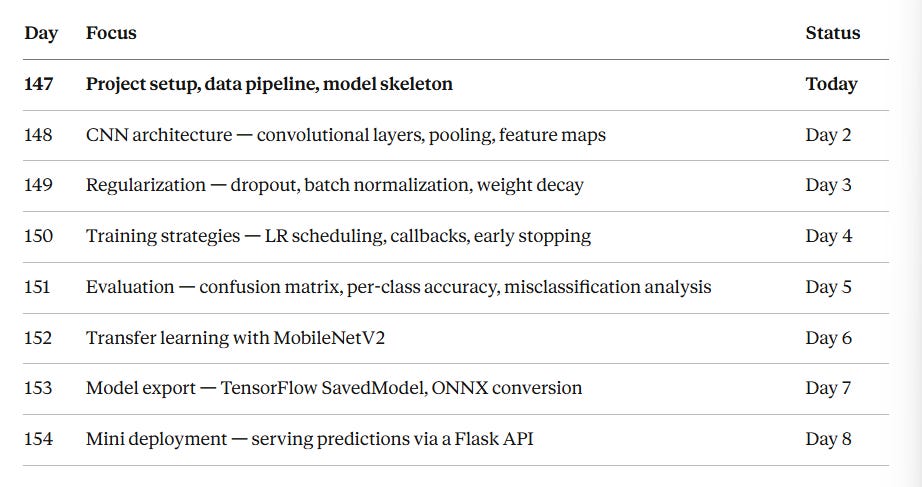
The 7-Day Project Arc
Before writing a single line of code, understand what the week looks like:
Instructor Note: Today is the foundation. Get this wrong and every subsequent day compounds the error. Get it right and the rest of the week flows cleanly.
Core Concepts
1. The Data Pipeline Is Not an Afterthought
In production ML, teams consistently report that 60–80% of engineering effort lives in data, not models. The model itself is often 50 lines. The pipeline that feeds it reliably — handling corrupted files, class imbalance, augmentation, batching, and prefetching — is where the real work happens.
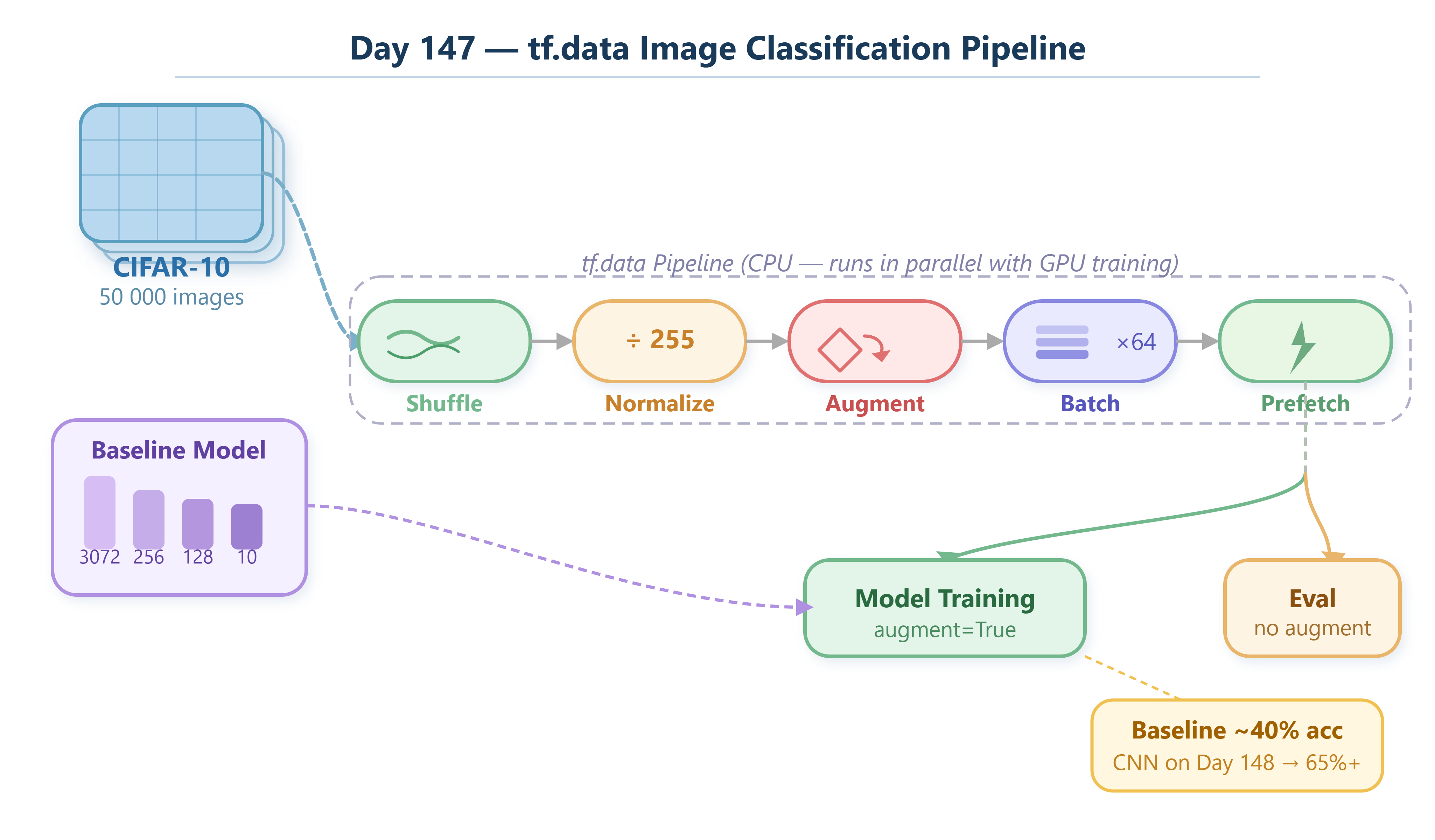
TensorFlow’s tf.data API is the production-standard answer to this. It is a lazy, composable pipeline that runs data loading and preprocessing on the CPU while the GPU trains the model in parallel. Netflix uses tf.data patterns for their recommendation system feature pipelines. Google Vision uses it to feed TPU clusters processing petabytes of images.
The Mental Model: Think of
tf.dataas a factory conveyor belt. Raw images come in one end. Normalized, augmented, batched tensors come out the other. The belt runs independently of the machine doing the work.
# Conceptual pipeline structure
dataset = tf.data.Dataset.from_tensor_slices((x_train, y_train))
dataset = dataset.shuffle(buffer_size=10000)
dataset = dataset.map(augment_fn, num_parallel_calls=tf.data.AUTOTUNE)
dataset = dataset.batch(64)
dataset = dataset.prefetch(tf.data.AUTOTUNE)
AUTOTUNE is TensorFlow telling the runtime: measure the actual hardware, then decide the optimal parallelism automatically. You never hard-code thread counts in production.